Choose your study task before choosing the timer. Reviewing a concept, answering questions from memory and rehearsing an exam section are different activities. They need different stopping points, and sometimes different durations.
A timer can help you keep a session within the time available. It cannot check whether an answer is correct or guarantee an exam result. This guide combines a practical session plan with research-supported learning principles; the example timings are adjustable.
Start with the assessment requirements
Find the current specification, question format, allowed resources and timing instructions from your course or exam provider. Note any approved access arrangements. A generic “exam timer” should not override those instructions.
List a few topics and identify an actual task for each: solve three equations, explain a process without notes, compare two arguments or check a marked practice answer. “Revise biology” is too broad to tell you what happened during a session.
Match the timer to the task
| Task | Timer choice | What to review afterward |
|---|---|---|
| Learn a difficult concept | A manageable work block | Can you explain an example? |
| Recall previously studied content | A short attempt, then checking time | Which answers were missing or wrong? |
| Practice an exam section | The provider's actual time allowance | Accuracy, completeness and pacing |
| Review feedback | A block for correcting selected errors | Can you solve a similar question now? |
For ordinary revision, try a 25-minute study session as a starting option. Choose a shorter or longer block if the task or your needs call for it. The silent timer is an alternative when sound would disturb others.
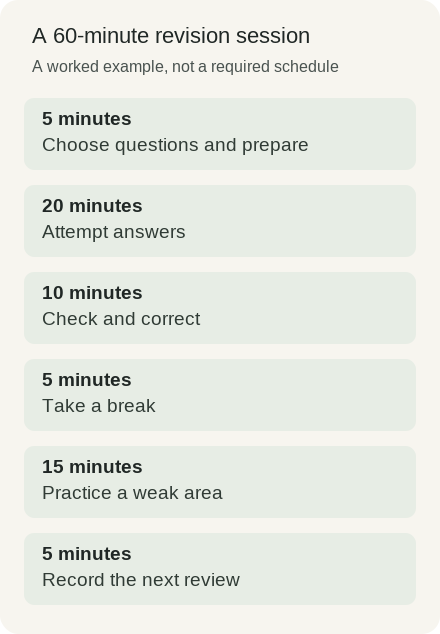
A worked one-hour revision session
- 5 minutes: Choose a topic and prepare three questions.
- 20 minutes: Attempt answers without looking at the solution, when appropriate to the task.
- 10 minutes: Check answers against reliable course material and mark gaps.
- 5 minutes: Take a break.
- 15 minutes: Work through one weak area and try a related question.
- 5 minutes: Record the next topic and a later review date.
The total is 60 minutes, including setup, feedback and a break. This is one possible arrangement, not a claim that an hour is the best study duration. Shorten the number of questions before removing feedback just to fit the clock.
Revisit content across days
The IES learning practice guide recommends spacing learning and using quizzes to revisit content. The timer controls one session; your calendar controls when you return.
A 2025 classroom study examined retrieval and spacing with real learning material. Its findings do not prescribe a universal countdown interval or establish that this particular one-hour plan is optimal. The useful distinction is between attempting to retrieve knowledge and simply spending more time looking at it.
A study published in October 2026 examined retrieval, working memory and material complexity in fourth-grade students. Results varied with task complexity and support. This is a reason to adapt practice to the learner and material, not to prescribe one timer setting for every age or subject.
Use timed practice for pacing, not every learning task
When practicing a timed section, use the applicable allowance and permitted materials. Afterwards, record unanswered questions and time-consuming steps as well as the score. A low result may mean a knowledge gap, unfamiliar instructions or a pacing issue; those need different follow-up.
You can also learn without a time limit. If rushing prevents you from understanding a worked example, stop treating speed as the immediate goal. Follow your course guidance when simulating assessment conditions, including any arrangements that apply to you.
Keep a short revision record
Write: topic, task, attempt result, correction, next practice question and next review date. Use that evidence to choose tomorrow's work. Do not count completed timers as proof that a topic has been learned.
Keep browser timers open and the device awake during use. Before a practice run, check the display and sound settings; do not depend on an inactive or closed tab as a guaranteed alarm.