A 90-day plan gives a longer project a review date. It does not make success automatic, and 90 days is not a scientifically established best duration for every goal. Use the period when it fits your project; shorten or extend it when it does not.
This guide walks through a learning project: create and publish a small portfolio website. The same worksheet can support a writing project, course or personal project without pretending that all goals take the same amount of work.
Define an outcome you can check
Replace “get better at web design” with “publish a three-page portfolio with a working contact link, readable mobile layout and three examples of my work.” List what is outside the project too: no shop, membership system or custom content platform in this example.
Separate the outcome from the activity. Three study sessions are an activity; a page someone can use is an outcome. Record both, so a busy week does not automatically count as progress.
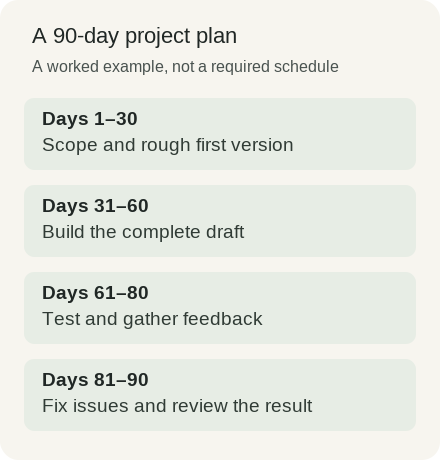
Work backward from the review date
Use the deadline calculator to examine your dates, then put the milestones in your own calendar. A timer is useful for a work session; it is not a substitute for a project calendar or reminders.
| Checkpoint | Evidence to review | Decision |
|---|---|---|
| By day 30 | A rough homepage and selected work samples | Is the scope realistic? |
| By day 60 | Three linked pages with draft text | What must be cut or fixed? |
| By day 80 | A mobile test and feedback from a reader | Which problems block publishing? |
| Day 90 | Published pages checked against the original criteria | Finish, reduce scope or revise the plan |
These dates are an example, not a required pace. Include waiting time for feedback and other commitments rather than filling every available hour.
Turn the next milestone into this week's work
For the first week, choose deliverables small enough to finish: collect three work samples, sketch the homepage and write a short introduction. Give each an available slot. For example, Tuesday and Thursday can each hold a 25-minute study session; Saturday can hold a longer session if it is genuinely available.
At the end of each block, note the next action. “Replace the placeholder image on the homepage” is easier to resume than “continue website.” Keep the page open and your device awake when relying on a browser timer.
Copy this weekly review
Use these prompts in a notebook or document:
- Outcome: What changed in the actual project this week?
- Evidence: Which page, draft, exercise or other deliverable demonstrates it?
- Time: Which planned sessions happened? Which estimates were wrong?
- Obstacle: Am I missing time, knowledge, feedback or a decision?
- Next step: What single deliverable matters most next week?
- Adjustment: What will I remove, move or ask for help with?
A missed week is information, not a reason to compress all the missed work into the next one. Recalculate available time before deciding whether the deadline still fits.
How much should you plan each day?
Start with your actual commitments. If only two evenings are free, plan two sessions rather than an imaginary daily routine. Leave room for interruptions and avoid using time spent as a score of personal worth.
For study-related goals, the US Institute of Education Sciences' learning practice guide recommends spacing learning over time and using quizzes to revisit content. That supports revisiting material across the plan; it does not validate a universal 90-day success rate.
What if the goal depends on other people?
A promotion, acceptance or audience response is not wholly under your control. Track actions and quality standards you can influence, then record the external result separately. On day 90, compare the evidence with your original criteria and decide what to do next. Do not rewrite the starting target just to make the result look successful.
Put what you've learned into practice with our free tool
Open Deadline Calculator →