A reading timer can reserve space for reading and reflection. It should not turn every text into a speed test. A dense explanation, a novel and an article you are evaluating for an assignment require different approaches.
Decide first what you need from the text: an overview, an argument you can explain, instructions you can follow or evidence for a particular question. That purpose determines what you read closely and what you record.
Preview before setting a page target
Check the title, headings, author, date and source. Ask what the text is trying to do and whether it fits your question. For an online source, follow important references rather than assuming a polished page or AI-generated summary is accurate.
Choose a manageable section. A fixed page target can be misleading when one section contains diagrams, equations or unfamiliar terms and another is mostly narrative.
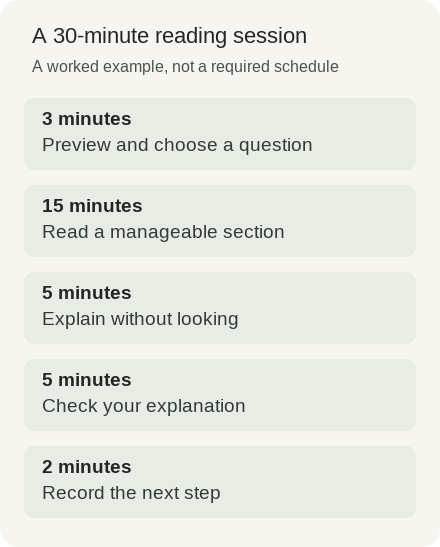
A worked 30-minute reading session
| Minutes | Activity | Question |
|---|---|---|
| 0–3 | Preview and set a purpose | What am I trying to find out? |
| 3–18 | Read one section carefully | What is the main claim and support? |
| 18–23 | Put the text aside and explain it | What can I reconstruct without looking? |
| 23–28 | Reopen and check the explanation | What was wrong, missing or overstated? |
| 28–30 | Write a next step | What should I revisit or investigate? |
The example totals 30 minutes. If the passage needs more time, read less material or extend the plan deliberately. Do not skip checking your explanation simply to finish a certain number of pages.
Use questions that test understanding
After reading, try two or three prompts:
- What is the main point in my own words?
- Which example or evidence supports it?
- How does this connect to something I already know?
- What remains unclear or unsupported?
- Where would this idea apply, and where might it not?
For a story, ask about a character's decision, a change in perspective or a detail that supports your interpretation. For instructions, explain the sequence and test it in the appropriate safe setting. These are different comprehension tasks, not one universal quiz.
What learning research supports
The IES practice guide recommends revisiting material through quizzes and asking explanatory questions. These principles support checking understanding; they do not validate a fixed reading speed.
A 2025 primary-school classroom study examined retrieval with learning texts. Its population and tasks differ from every adult reading situation, so it should not be treated as proof that the exact routine above works equally well for all texts.
Choose a quiet timer setup
Use the study timer for a single reading block or the silent timer when sound would disturb you or others. Keep the page open and the device awake. The timer does not track pages, assess comprehension or schedule later reading automatically.
If clock-watching distracts you, leave the display out of your main line of sight or use a written start and finish time instead. Reading for pleasure does not need to be measured at all.
Keep a useful reading note
Record the source, section, question, short explanation, page or passage reference and next action. Include enough detail to find the original again. Separate your interpretation from the author's claim, particularly when you will cite it in assessed work.
If recall is weak, reduce the section size or explain one example before proceeding. If the text is unclear, consult another reliable explanation. The goal is a checked understanding, not a large count of completed countdowns.
Put what you've learned into practice with our free tool
Open Reading Study Timer →